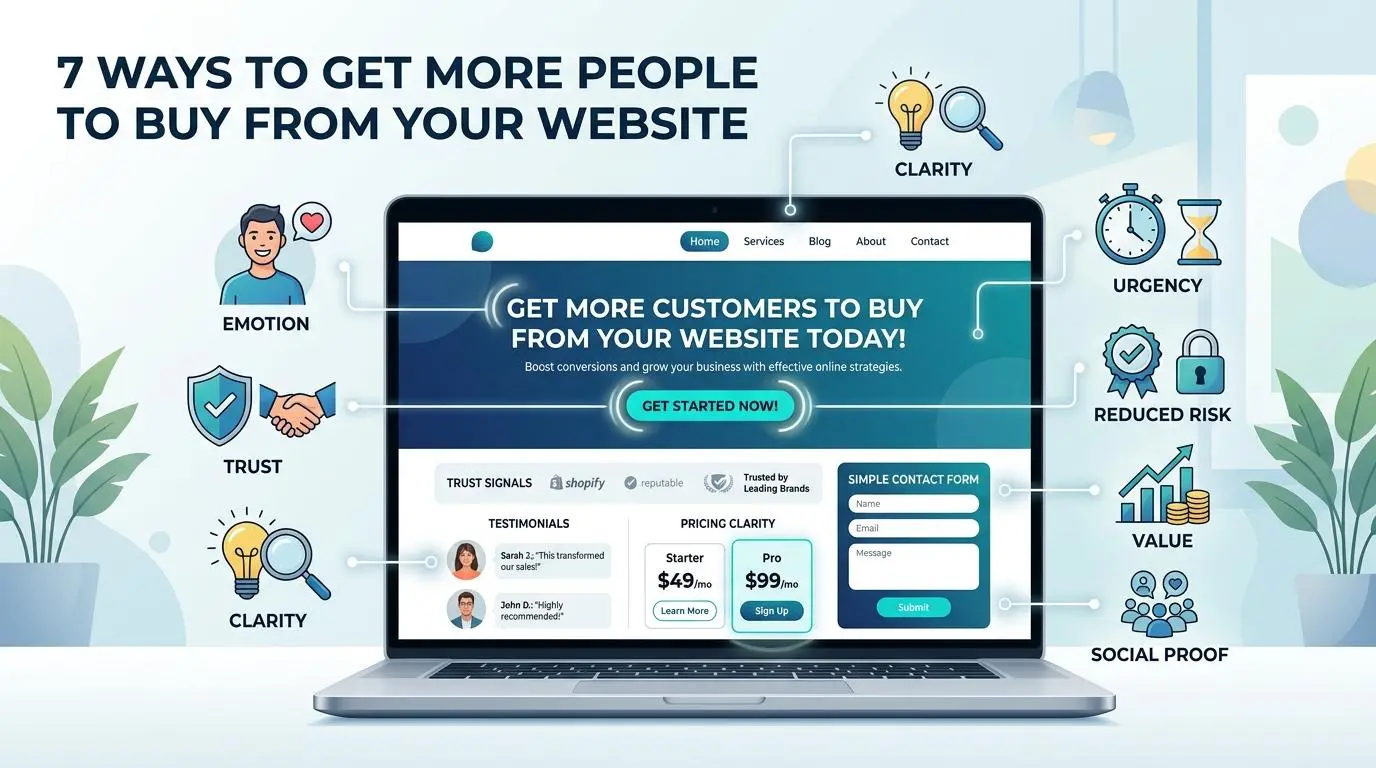
7+ Ways to Get People to Buy From Your Website

TL;DR Summary: People do not buy from websites just because the offer exists. They buy when the problem feels real, the outcome feels clear, and the next step feels safe. If your website can speak to pain, reduce uncertainty, and make the value obvious, you will convert more visitors into customers. Do not just describe what you deliver. Describe what becomes easier, clearer, safer, faster, more profitable, or less stressful after someone chooses you.
A lot of business websites do this backward.
They explain the company. They list services. They talk about features. They hope the visitor will connect the dots and decide to reach out.
But that is not how most people buy.
- People buy when they feel understood
- They buy when the problem feels urgent enough to fix
- They buy when the result sounds worth it and the risk feels manageable
If your website does not help people get to that point, it may be informative, but it will not be very persuasive.
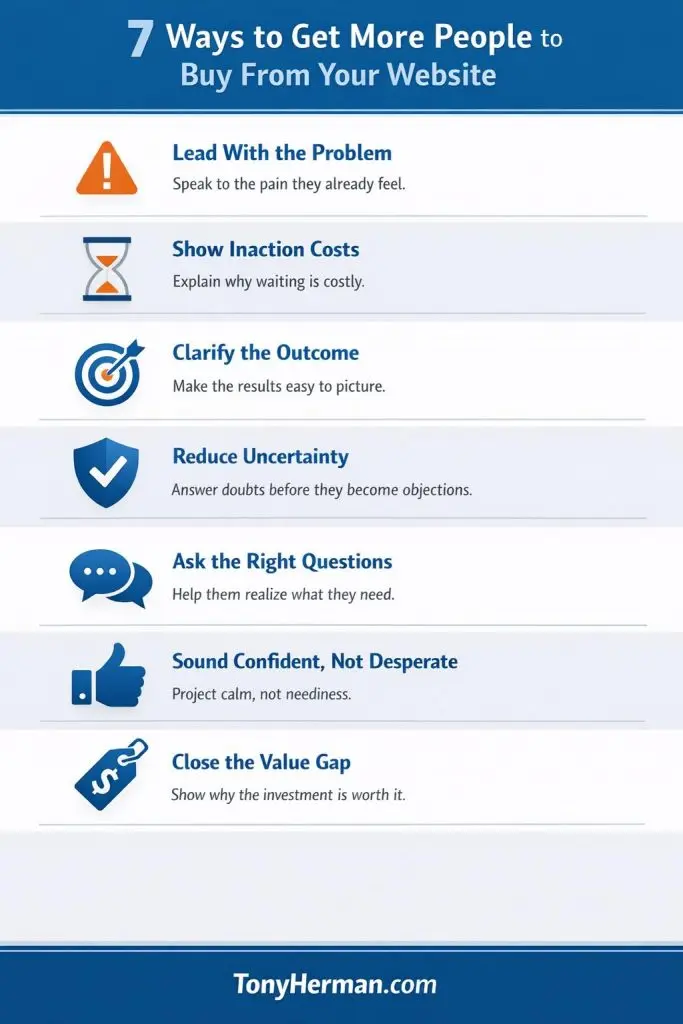
Here are seven practical ways to make your website do a better job of turning visitors into buyers.
Quick Pre-Check
A simple way to check whether your message is doing its job is to ask four questions:
- What do you sell?
- Who is it for?
- How does it help them?
- Why should they choose you instead of doing nothing, choosing someone else, or trying to handle it themselves?
Most websites answer the first question. Some answer the second. But the strongest websites make the last two painfully clear. They help visitors see what changes for them and why this business is the right one to help make that change happen.
1. Lead with the Problem They Already Know and Feel
Most people do not land on a website hoping to admire a well-organized service menu (that’s funny, right?). They land there because something is wrong, frustrating, broken, unclear, slow, expensive, or not working the way it should.
If your page opens with a generic welcome message, you are wasting valuable space (Ugh, I hate seeing this – what are we, in 2004?). Start with the problem your customer already feels in their day-to-day life.
For example:
- An HVAC company customer may be worried about high utility bills or uneven temperatures.
- A dental patient may be nervous about pain, cost, or putting off treatment too long.
- A website owner may be frustrated because traffic is not turning into leads.
When people feel like you understand the problem clearly, they are much more likely to keep reading.
2. Show Why Waiting Costs More Than Taking Action
People often stay stuck because doing nothing feels easier in the moment. Your website needs to gently show them that staying the same has a cost, too.
This is where many websites get too polite. They mention the service, but they never show what happens if the visitor waits another month, another season, or another year.
That cost could be:
- Lost leads from a weak website
- More expensive repairs later
- Missed revenue from poor messaging
- Ongoing stress from a problem that keeps hanging around
You do not need fear tactics. You just need honesty. People move faster when the cost of inaction feels real.
3. Make the Outcome Crystal Clear
A surprising number of websites talk a lot about what is included and very little about what actually gets better. Features matter, but they are not the first thing most people care about. Buyers want to know what changes after they say yes. Instead of only saying what you offer, explain what that offer helps them achieve.
For example, instead of:
- 5-page website
- Monthly maintenance
- SEO package
Connect those to outcomes like:
- A clearer first impression
- Less stress when updates are needed
- More chances to show up when people search for your services
People buy progress. Your website should make that progress easy to picture.
And stop trying to sell the product itself. Sell the dream version people have of themselves with the product.
This is where many businesses accidentally describe their work instead of describing the difference that work makes.
Saying, “We design clean, modern websites,” may be true, but it does not tell a business owner what gets better after they hire you. A stronger message might be: “We help your business look established, credible, and easy to choose before someone ever calls.”
Saying, “We create end-to-end user experiences,” may sound impressive, but it is still focused on the process. A clearer version is: “We make complicated products feel simple from the first time someone uses them.”
Saying, “We build design systems,” explains the deliverable. But the outcome is more compelling: “We help your team move faster, stay consistent, and ship better work without reinventing everything every time.”
Your visitor does not just want to know what you can produce. They want to know what life, work, or business will feel like after the problem is handled.
4. Reduce Uncertainty Before it Becomes an Objection
Many objections are not really about price or timing. They are about uncertainty. People do not purchase when they are confused. People purchase when they feel comfortable, therefore, your task is to clear doubts, not bombard them with facts.
When someone says, “I need to think about it,” they are often really saying, “I am not sure this will work for me.”
Your website can help lower that hesitation by answering the questions people are already asking in their heads:
- What exactly happens next?
- How long will this take?
- What does this cost?
- Will I be locked into anything?
- Have you helped people like me before?
The more clearly your website removes unknowns, the less resistance people feel.
5. Use Your Website to Clarify, Not to Pressure
Good sales copy is not pushy. It is clarifying.
The best websites help people realize what is wrong, why it matters, and what a better option looks like. They do not yell. They do not over-hype. They simply make the decision easier to understand.
This often means asking better questions in your copy:
- Is your current website actually helping you get calls?
- Are people landing on your page and leaving without taking action?
- Are you explaining your service, but not giving people a reason to care?
When people reach the conclusion themselves, they tend to trust it more.
What I like to say is, make your offer so clear, understandable, and desirable that they’re frantically looking for where to sign up or buy. Have a calm, cool, and confident pitch – not a desperate-sounding one with call-to-action buttons all over the place.
Let’s dig into this, actually…
6. Sound Confident, Not Desperate
Desperation has a smell to it. People can feel it on a website.
When the copy feels needy, over-eager, or too aggressive, trust drops. On the other hand, when the message feels steady, clear, and grounded, authority goes up. This does not mean being cold. It means sounding like someone who understands the problem, knows how to help, and does not need to chase everyone who visits the page.
Calm confidence converts better than pressure.
7. Fix the Value Gap Before Blaming the Price
When people hesitate at the price, it does not always mean the price is wrong. Often, it means the value has not been made clear enough yet.
If the outcome feels vague, the price feels expensive. If the transformation feels specific, useful, and believable, the price becomes easier to understand.
This is why your website should not just list what is included. It should explain:
- What problem this solves
- What gets easier or better
- Who this is for
- Why your approach is worth trusting
People do not need every detail up front, but they do need enough clarity to feel like the investment makes sense.
Before you blame your price, look at whether your page clearly answers these four things:
- What do you sell? Be specific enough that the right visitor knows they are in the right place.
- Who is it for? Help people recognize themselves in the page.
- How does it help? Describe the practical and emotional improvement they get from saying yes.
- Why choose you? Give them a believable reason to trust your experience, process, proof, approach, or point of view.
That last part matters. “Why choose us” is not just a place for generic claims like “quality service” or “customer satisfaction.” It is where you explain what makes your approach worth trusting and what someone can expect to be different about working with you.
Who Are You Talking To?
Let’s make this simple:
- Sell women confidence
- Sell men status
- Sell parents peace
- Sell busy people efficiency
- Sell beginners direction
The point is not to reduce people to stereotypes. The point is to understand the deeper result they are trying to get.
Someone may technically be buying a website, a roofing repair, accounting help, a course, or a new software tool. But underneath that purchase, they may really be buying confidence, peace of mind, control, speed, clarity, status, less stress, or the feeling that they finally have the right person helping them.
Good website copy connects the practical thing you sell to the better situation the buyer wants to be in.
What a Good Sales Funnel Should Actually Feel Like
A lot of people talk about funnels like they are machines. Build the page. Send the traffic. Add the button. Hope people convert. But from the buyer’s side, that is not what it feels like at all.
A sales funnel feels more like an experience. A conversation. A series of moments where someone is deciding, “Do I feel understood here?” “Does this make sense?” “Do I want to keep going?”
If your website is not converting well, sometimes the issue is not traffic or even the offer itself. Sometimes it is that the buying experience feels awkward, confusing, rushed, or one-sided.
A. It should feel like a really good first date
Think about a good first date. The other person asks thoughtful questions. They listen. They are engaged. The conversation builds naturally. By the end, you feel more comfortable than you did at the beginning, and you want to keep going.
That is what a good sales funnel should feel like.
Your website should make the visitor feel understood. It should show that you get what they are dealing with, what they are worried about, and what they are hoping to fix.
What it should not feel like is someone talking about themselves the whole time and then asking for commitment before trust has even had a chance to build. Who likes that?
That is what a lot of websites do. They lead with company history, service lists, features, and generic claims, then jump straight to “Contact Us” or “Buy Now.” – blah!
That is not a smooth buying experience. That is a bad date.
B. It should feel like a helpful shop owner, not a giant catalog
Here is another way to think about it.
Imagine walking into a store looking for something specific. You explain what you need, and the owner says, “Yep, I know exactly what you’re looking for,” and takes you right to it.
That feels good. It feels easy. It feels like progress. Your website should do the same thing.
When someone lands on a page, they should quickly feel like they are in the right place. The page should guide them toward the right service, the right offer, or the right next step without making them dig through a pile of options.
What it should not feel like is being handed a 47-page catalog and told to “look around.” (this is gold)
Too many websites dump everything on the visitor at once. Too many choices. Too much text. Too many competing messages. Too many calls to action.
When that happens, people do not feel helped. They feel abandoned.
C. It should feel like a conversation that builds
The best funnels do not just repeat the same message louder and louder.
They build.
- Each section answers the next question.
- Each point increases clarity.
- Each step adds confidence.
- By the time someone gets to the call to action, they should feel more certain than they did when they arrived.
That is very different from a page that starts strong, gets repetitive in the middle, and then suddenly asks for money at the end. If your website feels like a monologue instead of a conversation, that is a problem.
Good sales pages do not just talk. They respond to what the visitor is probably thinking:
- Is this really for me?
- Can I trust this?
- Will this actually help?
- What happens next?
When your page keeps answering those questions naturally, people stay with you.
D. Your funnel is not a machine. It is a relationship builder.
That may sound a little dramatic, but it is true. Every touch point on your website is part of a relationship. The headline. The examples. The layout. The offer. The call to action. All of it sends a message about what it would feel like to work with you.
So one of the best questions you can ask is not just, “Is this page optimized?”
Ask this instead:
“Would I want to be on the receiving end of this experience?“
If the answer is no, then the fix may not be more traffic or more marketing tricks.
The fix may be more empathy.
When your website feels more human, more helpful, and more thoughtful, people are much more likely to trust you. And when they trust you, they are much more likely to buy.
E. Provide what they need to believe
They must believe in three things. The product works, that you can assist them, and that they can do it (or that you will do it) – that is all.
Don’t Forget About Proof – It’s Needed
There are 3 types of proof that are needed:
- Competency proof – Does this person have the expertise?
- Results – Has this person helped anyone? Have results, before and after, testimonials.
- Empathy – Does this person understand me? Talk about their fears, worries, etc.
It must be done in this order because one leads to another. It’s a system / formula. Each one provides a foundation for the next one.
Bonus #1: Give People Relief
What makes people want to buy? Make them feel like they’ve finally found what they’ve been looking for. Give them the answer. Give them relief from whatever they are experiencing. Explain how you’ll take their pain and give them relief. They need to exhale. They need to say, “Ah, this is it” in their mind. That’s it. That’s all you have to do, really.
What are they actually experiencing right now?
- Are they overwhelmed?
- Have they tried things that didn’t work?
- Are they skeptical?
- Are they tired?
- What are they?
Are they looking for a plumber that gives straight answers and honest quotes?
Probably. Say you do that – plain and simple.
Solve their problem. Handle their problem. Give them relief that they’ve finally found what they’ve been looking for. When you copy (page text) says that, you’ve got them.
Bonus #2: How to Sell Anything You Want
From the moment you try to sell something, people become aggressive because you are trying to get their money, and who would want to lose their money?
It should be understood that people do not like products. What might surprise you, people do not even like the benefits from these products. As we all know, “sell the benefits, not the product.” True, but incomplete. Not only will you not sell them any benefits, but you must offer a rational way to achieve those benefits.
For example, everyone wants to make money. But scream, “Make $10,000 per month without any experience within 30 days,” and still, you will have to beg for conversion. Why? Because you did not provide any logical way. You see, there wasn’t anything for people’s brains to think about. Yes, that makes total sense:
People desire valuable things, but they also desire rational things.
When the rationality fails, trust fails. When trust fails, the sale fails. And selling only the benefit of the product is insufficient too.
If you manage to convince people about the benefit of the product and provide a rational way to obtain it, you can sell anything you want.
Here’s the Prompt for It:
Write a sales page about [YOUR TOPIC] in a persuasive style that focuses on both desire and logic.

Do not just sell the product or the benefits. Make the reader want the outcome, but also give them a rational, believable reason to think this offer can actually help them achieve it. The writing should explain or imply a clear path from where they are now to the result they want.

Use these principles:
- People do not trust big promises unless there is a logical path behind them
- Benefits alone are not enough
- Desire gets attention, but credibility gets conversion
- The offer should feel both valuable and rational
- When logic is weak, trust drops
- When trust drops, the sale drops

Writing style:
- Clear, direct, and intelligent
- Persuasive without sounding hypey
- Confident, but grounded
- No fluff, no exaggerated claims, no cheesy sales language
- Write like a smart marketer who understands buyer psychology
- Use plain English
- Keep the reasoning easy to follow

Structure:
- Start with a strong hook built around a painful problem, desired outcome, or common frustration
- Agitate the problem in a believable way
- Explain why most solutions or offers fail to convert people: they promise benefits without giving a logical reason to believe
- Present [YOUR TOPIC] as a credible, realistic path to the desired outcome
- Show how it works in a way that feels practical and believable
- Include examples, specifics, or mechanisms that make the offer feel real
- Build trust throughout
- End with a call to action that feels sensible, not pushy

Important:
Do not write vague claims like “get rich fast” or “transform your life overnight” unless you are using them as examples of what not to do. Every promise should feel supported by reason. Make the reader feel, “This makes sense. This feels possible. I trust this.”
Bonus #2: The One Magic Word that Sells
When you add the word “because” to any phrase with any reason, you’ll see compliance and conversions go up.
For example: “Go to SiteAnalyzerFree.com because without the free website scan there, you won’t know what’s wrong with your website.”
See?
What This Means for Your Website
If you want more people to buy from your website, do not just add more information. Make the information work harder.
Your pages should help people quickly understand:
- The problem you solve
- Why it matters now
- Why it gives them relief for a problem they have
- What result they can expect
- A rational way to get there
- Why they can trust you
- What to do next
That is what moves a visitor from “just looking” to “this might actually be for me.”
Here’s the Master Prompt for All of This
Write a sales page about [YOUR TOPIC] that helps the reader quickly and clearly understand all of the following:

- The problem this solves
- Why that problem matters right now
- Why solving it would bring relief
- What result they can realistically expect
- The rational path for how this offer helps them get that result
- Why they should trust this offer, company, or person
- What they should do next

The page should be persuasive, but grounded. Do not rely on hype, vague claims, or empty excitement. The goal is not just to make the reader interested. The goal is to make the reader think:

“This solves a real problem.”
“This matters right now.”
“This feels like relief.”
“This result sounds useful.”
“This actually makes sense.”
“I trust this.”
“I know what to do next.”

Writing style:
- Clear, direct, and smart
- Conversational but professional
- Plain English, not corporate language
- Persuasive without sounding pushy
- Confident without overstating
- Focused on clarity, trust, and action
- No fluff, no filler, no clichés
- Do not sound like a generic copywriter or an overexcited marketer

Core persuasion principles:
- People do not buy just because they want a benefit
- They also need a believable, rational path to that benefit
- Desire gets attention, but logic builds trust
- Trust is what makes conversion possible
- Every important claim should feel supported, explained, or made believable
- The offer should feel useful, timely, practical, and credible

Structure the page so it naturally answers these questions for the reader:

1. What problem does this solve?
Make the problem specific and easy to recognize. Show that you understand the frustration, risk, cost, inconvenience, confusion, or missed opportunity they are dealing with.

2. Why does this matter now?
Explain why this problem is worth paying attention to now, not someday. Show the consequence of delay, the cost of staying stuck, or the reason the reader should care today.

3. Why does this bring relief?
Show the emotional payoff of solving the problem. Help the reader feel the relief, clarity, saved time, reduced stress, improved confidence, or regained control that comes from fixing it.

4. What result can they expect?
Describe the outcome in a realistic, useful way. Focus on the transformation, improvement, or practical win. Avoid exaggerated promises.

5. What is the rational way to get there?
This is critical. Do not just sell benefits. Explain how the offer works in a believable way. Give the reader a logical reason to think this can help them get the result. Include mechanisms, steps, examples, proof, or specifics that make the offer feel real.

6. Why should they trust this?
Build trust throughout the page. Use concrete details, honest language, sensible claims, proof points, experience, examples, or clear reasoning. Do not just say “trusted” or “proven.” Show why.

7. What should they do next?
End with a clear and simple call to action. Make the next step feel obvious, low-friction, and sensible.

Additional instructions:
- Lead with the problem, stakes, or desired outcome
- Keep the page easy to scan
- Use strong section headings
- Make each section earn its place
- Include specifics wherever possible
- Show the difference between what the offer includes and what it helps the buyer achieve
- Keep the reader moving logically from problem to trust to action
- Avoid writing anything that sounds fake, inflated, or too good to be true
- If using examples, make them simple and believable
- If the topic is technical, explain it clearly without dumbing it down
- If the topic is emotional, keep it grounded in practical reality

Do not write a page that only sounds good.
Write a page that feels useful, credible, and convincing because it makes sense.

Now write the sales page for: [YOUR TOPIC]
Did I not promise gold? 🙂
Final Thought
People do not buy from websites because the business owner worked hard on the page. They buy because the message connects, the problem feels understood, the risk feels lower, and the result feels worth it.
A good page should make people feel, “You understand what I need, this can help me, this makes sense, and I know why I should choose you.”
If your website can do those things clearly, it will not just attract visitors. It will do a much better job of turning them into customers.
Key Takeaways:
- Lead with the problem your visitor already feels.
- Show the cost of waiting, not just the benefit of acting.
- Make the outcome clear, not just the deliverables.
- Show them how they will get relief.
- Reduce uncertainty before objections show up.
- Use your copy to clarify the decision, not pressure the reader.
- Sound confident and steady, not desperate.
- Provide a rational way that this will happen.
- If people hesitate at the price, there may be a value gap in the message.
📄 Download a PDF of This Article