People Don’t Buy Information Anymore – They Buy Results
 Reading Time: 8 minutes
 TL;DR Summary: Position your product or service around results, not just information. In a world where basic knowledge is easily accessible (ChatGPT / AI, search), people want to buy the result / progress. Learn how to shift your offer from "here's what to know" to "here's what you'll achieve" to drive conversions and success online. Read on for the full explanation, strategies, practical examples, and a free prompt to enhance your positioning and attract customers seeking tangible outcomes.
Author’s Note:
Something important has changed. This is a big warning to anyone with a website, be sure you read this if you want your website to convert and have success online. The rules have changes… a lot.
If you read this article, you’ll be able to save time and trouble (mistakes) when marketing online. The examples here are great.
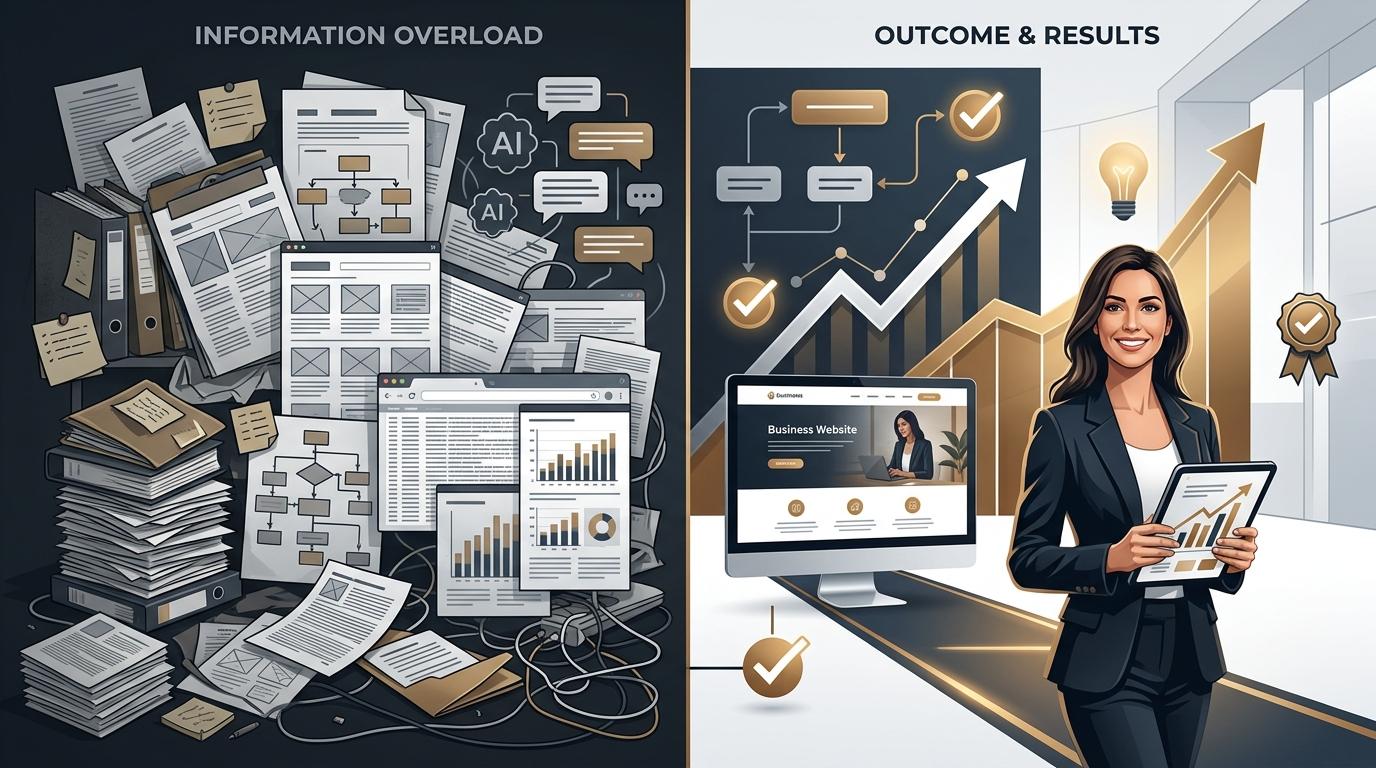
People can get information anywhere now. They can Google it, watch a video about it, or ask ChatGPT and get a decent answer in seconds.
That means “information” by itself is worth less than it used to be.
That does not mean people have stopped buying.

It means they are buying something different.
They are buying:
- Results
- Speed
- Clarity
- Accountability
- Systems
- Processes
- Customization
- Implementation
- Confidence
- Help getting from point A to point B
That is the real shift.
If your product, service, course, coaching program, or sales page is still built around “here’s some information,” you have a problem. Not because your information is bad. Because information is now easy to get.
What people still pay for is progress.
The Old Offer Was “here’s what to know”
For a long time, people could sell access to information. That worked because information was harder to find, slower to organize, and more valuable on its own. Now that basic answers are available almost instantly, a lot of offers feel weaker than they used to. Not because the topic is bad. Not because the creator is bad. Because the positioning is off.
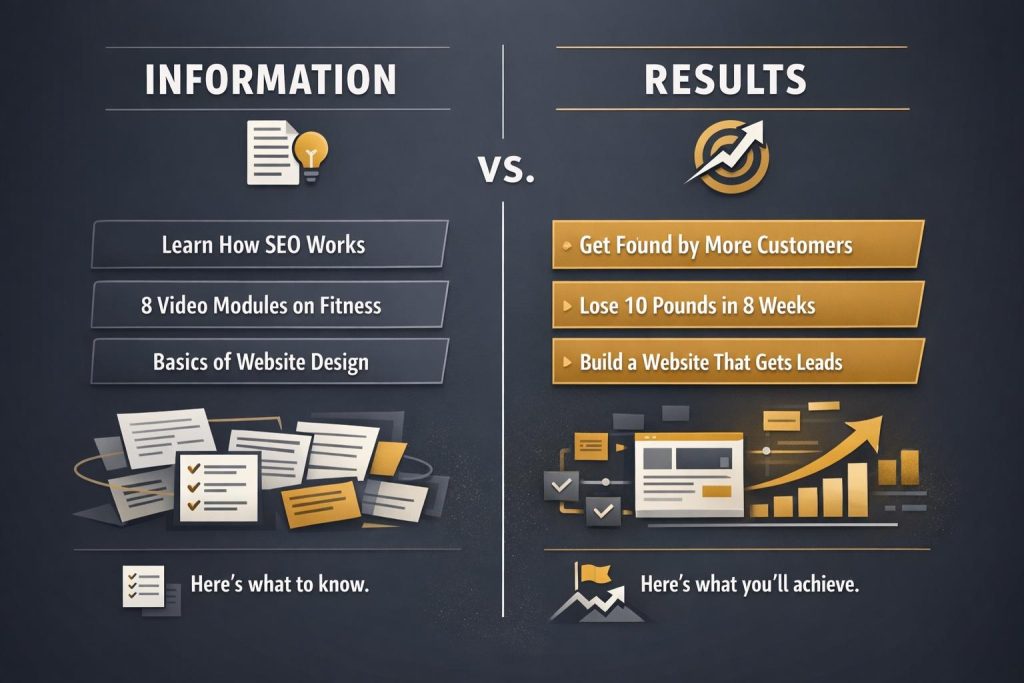
There is a big difference between these two offers:
- Information offer: “Learn how SEO works.”
- Results offer: “Get found by more of the right customers.”
- Information offer: “Here are 8 modules on fitness.”
- Results offer: “Lose 10 pounds and build better habits over the next 8 weeks.”
- Information offer: “Learn website design basics.”
- Results offer: “Get a website that looks credible and brings in more leads.”
That difference matters more than ever.
People Still Pay, But They Pay for a Better Outcome
People are not done buying. They are just less interested in paying for raw knowledge alone.
They will still pay when your offer helps them:
- save time
- avoid mistakes
- follow a system
- get personalized advice
- stay accountable
- move faster
- reduce risk
- finish what they started
That is why systems, guided processes, implementation help, templates, checklists, coaching, reviews, audits, and done-for-you services still have real value.
Information tells me what. A result helps me get to done.
25 Great Examples of Information vs. Results
Here is what this looks like in the real world.
Business and marketing
- Information: Learn Facebook ads.
- Result: Get qualified leads without wasting your budget.
- Information: Learn email marketing.
- Result: Turn more subscribers into buyers.
- Information: Learn copywriting.
- Result: Write pages that get more people to click, call, or buy.
- Information: Learn SEO basics.
- Result: Show up for searches that can actually bring you business.
- Information: Learn branding.
- Result: Look more trustworthy and memorable to the right customers.
Websites and digital services
- Information: Learn WordPress.
- Result: Launch and manage a site you are proud to send people to.
- Information: Learn conversion optimization.
- Result: Get more leads from the traffic you already have.
- Information: Learn website speed best practices.
- Result: Make your website load faster and frustrate fewer visitors.
- Information: Learn local SEO.
- Result: Help nearby customers actually find your business.
- Information: Learn analytics.
- Result: Understand what is working so you stop guessing.
Fitness and health
- Information: Learn how to work out.
- Result: Build a routine you will actually stick with.
- Information: Learn nutrition basics.
- Result: Eat better without overthinking every meal.
- Information: Learn about strength training.
- Result: Get stronger and feel better in daily life.
- Information: Learn mobility exercises.
- Result: Move better and feel less stiff.
Money and finance
- Information: Learn investing basics.
- Result: Start building a real portfolio with the money you have now.
- Information: Learn budgeting.
- Result: Stop wondering where your money went every month.
- Information: Learn credit scores.
- Result: Improve your credit and qualify for better options.
Career and work
- Information: Learn interviewing tips.
- Result: Walk into interviews more confident and prepared.
- Information: Learn management theory.
- Result: Lead your team better and reduce confusion.
- Information: Learn productivity methods.
- Result: Get more done without feeling scattered all day.
Skills, hobbies, and learning
- Information: Learn guitar chords.
- Result: Play the songs you actually want to play.
- Information: Learn skiing technique.
- Result: Ski with more confidence and more control.
- Information: Learn photography settings.
- Result: Take photos you are excited to share.
- Information: Learn cooking basics.
- Result: Make good meals at home without stress.
- Information: Learn public speaking.
- Result: Speak clearly without freezing up.
- Information: Learn app design.
- Result: Build something people actually enjoy using.
The Product May Stay the Same, but the Positioning has to Change
This is the part people miss.
You do not always need a brand-new product. Sometimes your product is fine. Your service is fine. Your course is fine.
The problem is that you are describing it like a table of contents instead of a better future. People do not buy a gym membership because they love ellipticals. They buy because they want to feel better, look better, and become a different version of themselves.
People do not hire a web designer because they are excited about layouts and font pairings. They hire one because they want a site that gives people confidence and helps turn attention into action.
People do not buy SEO because title tags sound fun. They buy because they want to be easier to find.
Details matter. Process matters. The work matters.
But those are not usually the thing people are paying for.
What People Want Now… and Have Always Wanted
In a lot of cases, buyers want one or more of these:
- A system: “Give me the steps in the right order.”
- A process: “Show me what to do first, next, and after that.”
- A shortcut: “Help me avoid wasting six months figuring this out.”
- Accountability: “Keep me moving so I do not stall out.”
- Support: “Answer my questions when I get stuck.”
- Customization: “Make this fit my situation, not someone else’s.”
- Implementation: “Do some of this with me or for me.”
- Confidence: “Help me feel sure I am doing this right.”
That is why simple information products are under pressure, but practical tools, templates, frameworks, coaching, communities, audits, reviews, and done-for-you services still have room to win.
Why will people give you their money?
They will part with money as long as you give them one or more these 4 things:
- Give them more money (make or save them money)
- Have them save time
- Lower their risk
- Elevate their status
Write your content that addresses one or more of these things. Build a pitch that way.
This takes away fear. The fear of losing $100 is twice as powerful as gaining $100. People want pain, fear, and problems to disappear. If you can reliably show it (gain their trust), and if you’re clear with your message, they will buy from you.
Think About It This Way: A Simple Formula
“Anyone struggling with X should get Y so that they can experience Z.”
You have a problem, product, and result. All are present here. This is your elevator pitch, too. Know it. Know what problem your product or service solves and always mention the result because people are buying the result. The “so that they can” (or just “so they can”) sets up the result.
And then if you can change “anyone” to be more specific. With that, you have the whole formula.
For example:
“Website owners struggling with conversion should get my course so they can experience more sales with the traffic they already have.”
That’s my pitch.
A Quick Test for Your Sales Page
Open your home page, sales page, or service page and read the headline and first few lines.
Then ask:
- Does this sound like a lesson plan?
- Does this sound like a list of modules?
- Does this sound like “here is what is included” before it says why it matters?
If so, rewrite it.
Lead with the result. Lead with the change. Lead with what is better after someone works with you, buys from you, or goes through your process. That does not mean making fake promises. It means saying clearly what the offer is meant to help people do.
A Better Way to Position Almost Anything
Here is a simple formula:
Instead of: “I teach people how to do X.”
Try: “I help people get Y by using X.”
Examples:
- “I teach local SEO” becomes “I help local businesses get found by more nearby customers.”
- “I teach meal planning” becomes “I help busy families eat better with less stress.”
- “I teach website design” becomes “I help businesses build websites that earn trust and generate leads.”
- “I teach productivity” becomes “I help overwhelmed people create a system they can actually follow.”
That is the shift.
Free Prompt: Add This to Your AI Profile or Prompt Library
Here is a free prompt people can save and reuse when they want AI to write with this angle in mind:
Write like a practical business strategist, not a hype marketer. Get to the point early. Avoid fluff, long intros, and vague statements. Focus on outcomes over information. Position offers, products, and services around the result, transformation, saved time, reduced risk, clarity, support, accountability, systems, and implementation help. Use plain English. Make the writing feel useful, grounded, and direct. Show the difference between “what it includes” and “what it helps people achieve.” Include specific examples. Make it sound like it was written for smart, busy people who do not want filler.You could also add this line:
When describing an offer, avoid making it sound like a table of contents. Make it sound like progress.Finally…
People still want to learn.
But in 2026, learning alone is usually not enough to make the sale.
If the internet and AI can give someone the basics in seconds, then your edge has to come from something more valuable than access to information. That “something more” is usually the result.
The clearer you are about the result you help create, the stronger your offer becomes.
That is true whether you sell a course, a service, a digital product, coaching, consulting, or a full-on done-for-you solution. People do not buy information anymore – AI provides that now. They buy what happens after the information is used well.
Visit TonyHerman.com (my home page) if you want help turning your offer, website, or messaging into something clearer, stronger, and more results-focused. And leave your comments/thoughts below please.
📄 Download a PDF of This Article