Easy Way to Uncover High-Converting Long-Tail Keywords

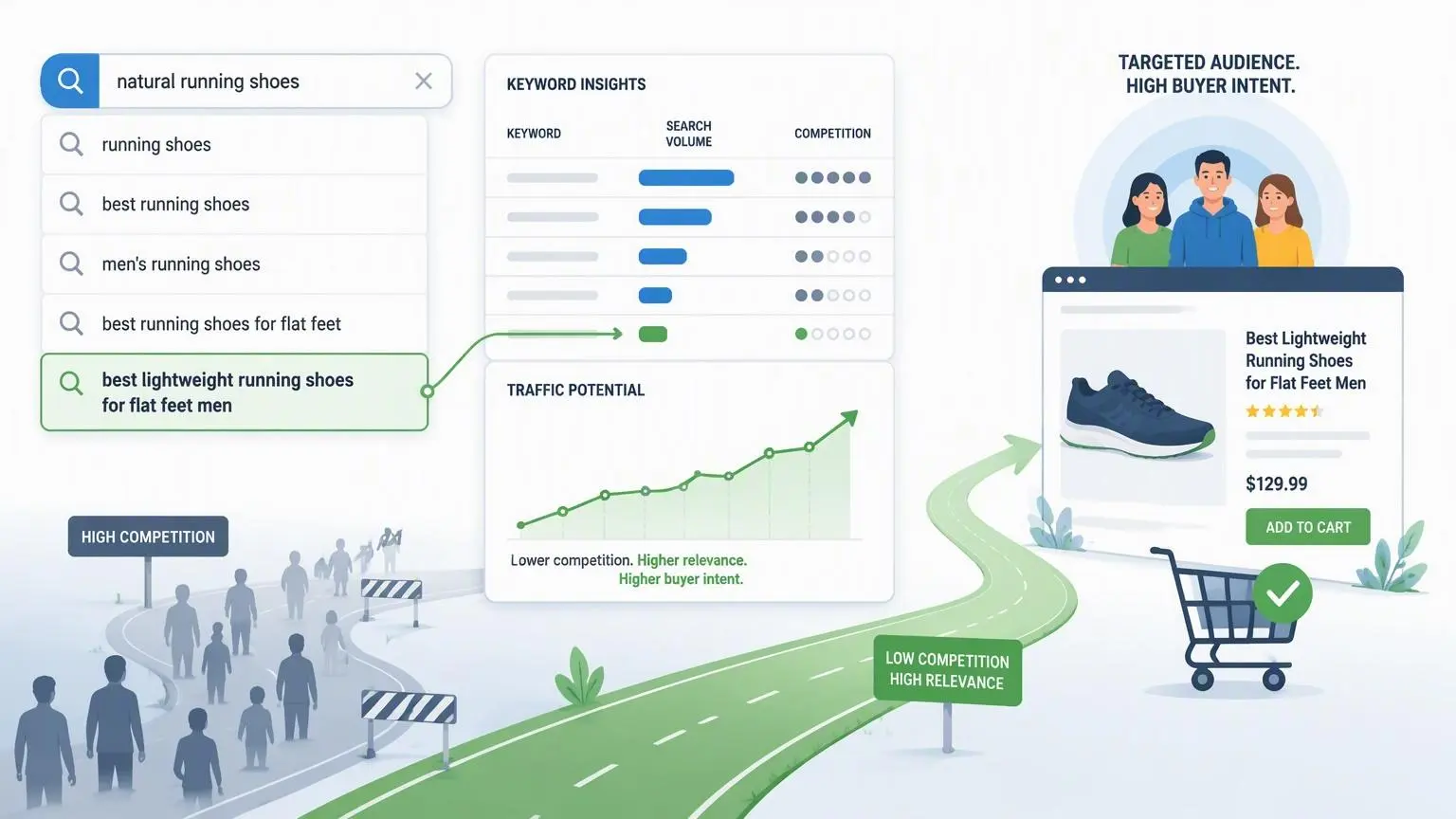
TL;DR Summary: One great way to get more traffic to your website is to go after low-competition, long-tail keywords, which are specific keyword phrases of 4 words or more. Those phrases can get really specific, and when people put in these kinds of searches, they are probably more likely to buy (high buyer intent). In order to find the best long-tail keywords, you should use data - phrases people are actually putting in. This article describes that.
Why Long-Tail Keywords Convert Faster: The Autocomplete Hack
While broad “head” terms (such as “accounting software” or “web design”) boast high monthly search volumes, they suffer from intense ranking competition and ambiguous conversion intent. In contrast, long-tail keywords represent multi-word search queries that reflect specific buyer problems, target demographics, and commercial intent. Because fewer competitors build dedicated resources tailored to exact long-tail queries, these search phrases are significantly easier to rank for on Page 1 and deliver substantially higher conversion rates.
Pro-Tip: Fast Long-Tail Mining with Autocompleter.app
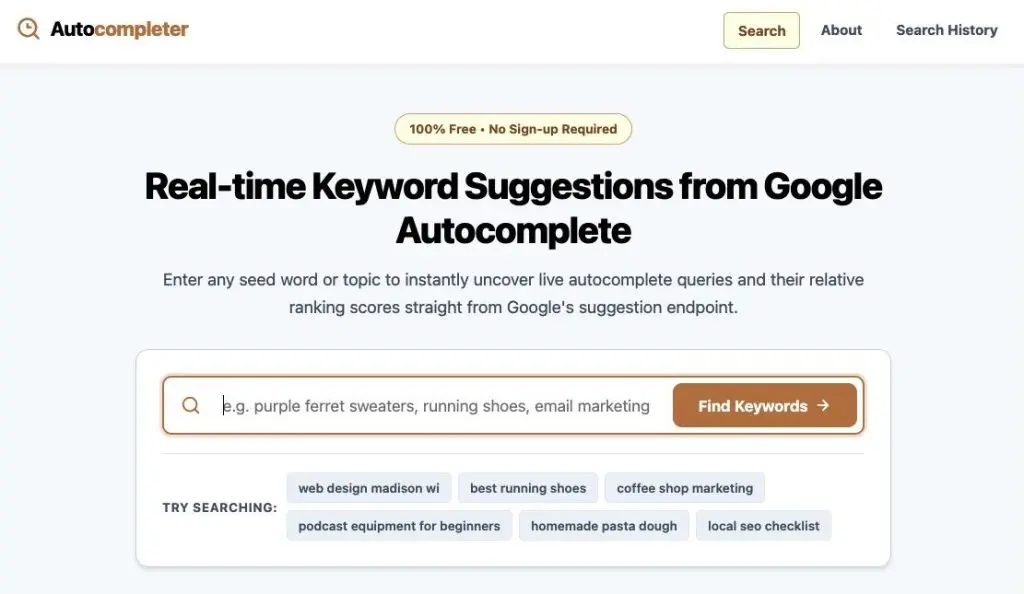
A fast and effective way to uncover real-time search engine autocomplete data is using Autocompleter.app. It scrapes and aggregates autosuggest predictions from Google, Bing, and YouTube to reveal what actual prospective buyers are actively searching for right now.
Here are three high-yield modifier patterns to uncover untapped long-tail keyword opportunities in any industry:
- Target Audience & Vertical Modifier (
[your industry] + for):
Enter your core industry, software, or service followed by"for"with nothing else after it (for example:"accounting software for","web design for","crm for","marketing agency for").
Why it works: Search engine autocomplete will immediately return the exact audiences, professions, and business verticals searching for your solution (such as “for therapists”, “for general contractors”, “for non-profits”, “for real estate agents”, or “for small law firms”). You can turn each discovered vertical into a dedicated industry landing page that converts at 3x–5x the rate of a generic homepage. - Head-to-Head Comparison & Decision Modifier (
[your product/industry] + vs.):
Enter your product, service, or major industry competitors followed by"vs."(for example:"shopify vs.","wordpress vs.","custom web design vs.").
Why it works: These queries capture high-intent prospects who are in the final comparison stage of their buying decision. Publishing unbiased comparison tables or “alternative” breakdown pages allows you to intercept ready-to-buy traffic looking for objective guidance. - Feature-Specific & Pain-Point Modifier (
[your product/industry] + without):
Enter your topic followed by"without"(for example:"website builder without monthly fee","seo audit without email","crm without coding").
Why it works: These searches surface the exact frustrations, friction points, and unwanted constraints buyers experience with mainstream market solutions. Highlighting how your offering eliminates these pain points gives you an irresistible value proposition.
How to Turn Autocomplete Discoveries into Organic Revenue
- Map Queries to Topic Clusters: Group related long-tail phrases under primary pillar pages or dedicated niche service landing pages.
- Address Intent Directly in Headings: Use discovered modifiers directly inside <h2> headings and FAQ accordions on your target page.
- Interlink with Striking Distance Pages: Pass internal link equity from your new long-tail guides back to your core commercial and category pages.
Was That All Gibberish to You? Here it is in Plain English
The core idea: Broad keywords like “accounting software” get tons of searches but are hard to rank for and don’t tell you much about what the searcher actually wants. Long-tail keywords — longer, more specific search phrases — have less competition, are easier to rank for, and convert better because they reveal exactly what problem someone’s trying to solve.
The tool: Autocompleter.app pulls real autocomplete suggestions from Google, Bing, and YouTube, showing you what people are actually typing right now.

Three ways to mine long-tail ideas – type in these phrases:
- “[your product] for” — reveals specific audiences searching for you (e.g., “CRM for real estate agents”). Turn each one into its own landing page — these tend to convert much better than a generic homepage.
- “[your product] vs.” — catches people actively comparing options right before they buy. A comparison page can capture that traffic.
- “[your product] without” — surfaces specific complaints or dealbreakers (e.g., “website builder without monthly fee”). Use these to highlight what makes your product different.
What to do with what you find:
- Group similar phrases together into themed pages/clusters rather than scattering them randomly.
- Actually use those phrases in your headings and FAQs so the page directly answers the query.
- Link these new pages back to your main product/category pages to boost their SEO strength too.
Bottom line: Instead of guessing at keywords, this approach uses autocomplete data to find low-competition, high-intent phrases, then builds pages specifically targeting them, which tend to rank faster and convert better than generic content.
📄 Download a PDF of This Article