How to Fix You Website For Free: The Checklist That Actually Works

TL;DR Summary: Use the 80/20 rule: focus on the small set of fixes that create most of the results. Start with clarity (what you do + who it’s for), then strengthen your “money pages,” tighten titles and headings, add internal links, and add FAQs. After that, use Google Search Console to track what improved.
Your website probably isn’t “broken.” It’s just quietly under-performing. The good news: you can make real improvements without paying for a redesign or buying a bunch of tools. You just need to fix the highest-impact stuff first.
The Problem With Most Websites is…
Here’s the problem: most sites are “fine” from the owner’s perspective, but confusing from the visitor’s perspective. People land, they don’t instantly understand what you do or what to do next, and they bounce.
I noticed this at my first job doing website design. We had a list of manufacturers, which the salespeople liked, but the customers coming to the website wanted to see the list of products by product type.
Also… Google. Google can’t confidently rank what it can’t understand. If your pages are vague, thin, or scattered, your SEO stalls even if you keep publishing content.
What a “fixed” website looks like:
- A visitor understands your offer in 5 seconds
- Every important page has one obvious next step
- Your core services have dedicated pages that answer real questions
- Your site has a clean structure and internal links that make sense
What Is The 80/20 Rule In SEO?
The 80/20 rule is simple: 20% of the work produces 80% of the results. In SEO, that usually means fixing the fundamentals before chasing “more content.”

If you do the basics really well, you’ll often see faster gains than someone who publishes weekly blog posts on top of a confusing site.
The golden rule of SEO
Make the page the best answer for a real human first. Then help Google understand it with clear titles, headings, internal links, and FAQs.
How to Fix Your Website For Free – Step By Step
This is the “free quarter” of the system. If you do nothing else, do these in order.
Step 1: Fix your home page message in 10 minutes
Write one clear sentence that passes the “five-second test.” Here’s a simple template:
We help [who] get [result] without [common pain].
Then put one primary call-to-action button above the fold. One button. One next step. If you offer too many options, people freeze.
Step 2: Build your money pages to convert
Convert? What’s that? This means convert traffic into customers / buyers / people who take some kind of action.
If you rely on one generic “Services” page, you’re making it harder for people (and Google) to understand what you actually do. Create one strong page per core service.
Each money page should include:
- What the service is and who it’s for
- What happens next and what it costs or how pricing works
- Proof: testimonials, photos, results, reviews
- FAQs that answer the real objections
- A clear CTA repeated 2–3 times
Step 3: Fix page titles and headings for a quick SEO lift
Titles and headings are how both humans and search engines understand a page. Quick rules:
- Your page title should match the page intent. Often this is Service + Location.
- Use one H1 per page and make it specific. Avoid “Welcome” or “Home.”
- Use headings that match how customers actually talk and search.
Step 4: Add internal links like you mean it
Internal links are the quiet lever most sites ignore. They help users find what they need, and they help Google understand what matters on your site.
On each important page, add 3–8 links to related services, your About page, your Contact page, and 1–2 relevant blog posts. Use plain-English anchor text, not “click here.”
Step 5: Add a simple FAQ block to your top pages
FAQs do three things fast: they improve clarity, build trust, and often help SEO. Add 6–10 FAQs to your homepage and your money pages. Answer in plain English and don’t dodge the real questions.
Step 6: Do a 30-minute technical quick check
How To Increase Your SEO Traffic In 30 Days
This is a realistic plan if you’re doing this yourself and you want measurable progress without going insane:
- Week 1: Fix your home page + your top two money pages.
- Week 2: Add missing money pages and add internal links between them.
- Week 3: Update pages that already get impressions in Search Console.
- Week 4: Publish one high-intent page that supports a money page and link to that money page.
Glossary of Terms:
- FAQ block: A section of common questions and answers added to key pages to improve clarity and trust.
- Internal linking: Links between pages on your own site that help users and search engines understand structure.
- Money page: A core service page designed to convert visitors into leads or sales.
- Search Console: Google Search Console – like a back-channel between Google and you, explaining what Google sees, what to fix, what to rank for.
- Search intent: What a person is actually trying to accomplish when they search a phrase.
Key Takeaways:
- Use the 80/20 rule: clarity and structure beat “more content” at the start.
- Fix your homepage message first, then strengthen your money pages.
- Titles, H1s, internal links, and FAQs are high-impact SEO basics that most sites under use.
- Run a quick technical check monthly so you don’t lose leads silently.
Want the Full Checklist to Fix Your Site?
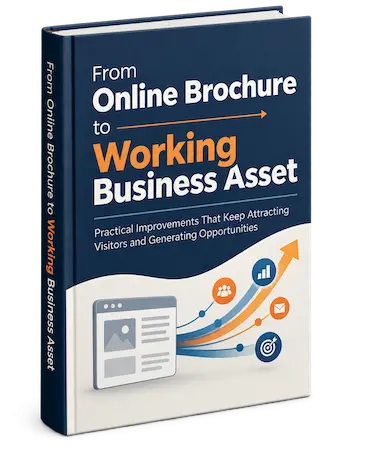
If you found this helpful, I have the complete step-by-step system (plus printable cheat sheets and checklists) available as a PDF: How to Fix Your Website.
It’s the full version of this process, organized so you can work through it without guessing what to do next.
I’ve put my 30+ years of website design knowledge into this easy to follow guide. I’ve kept it as short as possible because huge guides take too long to get through. I keep it practical and simple.
Just imagine finally getting this done. You do this work once, and it keeps working for you, 24/7 into the future.
BONUS: “10 Quick Fixes That Improve Your Website Fast”
📄 Download a PDF of This Article