What to Look for in Any Business Contract

TL;DR Summary: Ensure your business is protected by understanding the essential elements every contract must cover: scope, money, timeline, and exit. Don't overlook crucial clauses like auto-renewal, intellectual property, and dispute resolution. Take the time to review and negotiate contracts to avoid costly mistakes in the future. Read the full article for detailed guidance on safeguarding your business agreements.
Not legal advice—just practical, owner-to-owner guidance so you don’t sign something you’ll regret.
If you’re a business owner, speed is tempting: scan, sign, move on. The problem is that the fine print is the deal. Logos don’t protect you—paper does. Before you commit to a vendor, partner, freelancer, or platform, slow down and make sure the essentials are in writing and unambiguous.
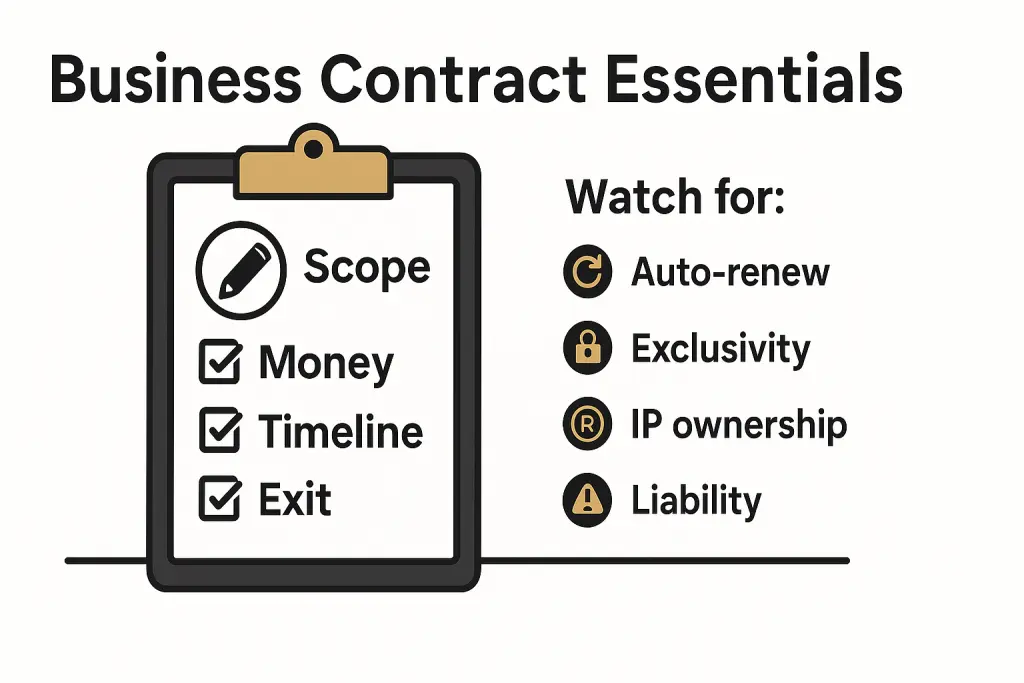
The Four Lines Every Contract Must Draw
If these aren’t crystal clear, you don’t have a deal—you have a risk.
1. Scope: What’s included—and what isn’t
- Deliverables: What exactly will be produced or performed?
- Standards: What does “done” mean (acceptance criteria, quality bar)?
- Out-of-scope: What’s explicitly excluded to avoid assumptions?
- Change process: How are additions handled (change orders, pricing)?
Quick test: Could a neutral third party read the scope and agree on what gets delivered without asking you questions? If not, it’s too vague.
2. Money: How much, when, and for what
- Pricing model: Fixed fee, hourly, retainer, or milestone-based?
- Payment timing: Upfront deposit, net terms, late fees, interest?
- Expenses: What reimbursables are allowed and with what proof?
- Increases: When and how can rates change?
Quick test: Could you generate an invoice schedule from the contract alone?

3. Timeline: When it starts, what happens when
- Start date & milestones: Concrete dates or event triggers.
- Dependencies: What do you owe (content, access, approvals)?
- Delays: What happens if either party slips (cure periods, re-plans)?
Quick test: If the project stalls, does the contract explain next steps?
4. Exit: How either side can end it safely
- Termination for convenience: Can you exit without a breach?
- Termination for cause: What counts as default and what’s the cure period?
- Refunds & final payments: Who owes what on exit?
- Wind-down: Handoffs, file delivery, access removal, confidentiality.
Quick test: Could you end the relationship without a fight? If the path isn’t clear, negotiate it now.
Clauses Owners Always Search For
Make sure you find these in any contract. If they’re not there, you don’t have them.
- Auto-renewal: Does it renew by default? What notice is required to cancel?
- Exclusivity / Non-compete: Are you blocked from using others or selling to certain customers?
- Intellectual Property (IP): Who owns the final work, raw files, and pre-existing materials? Is the transfer upon full payment?
- Confidentiality / NDA: What can be shared, with whom, and for how long?
- Warranties: What’s promised (performance, non-infringement) and for how long?
- Indemnification: Who covers third-party claims (e.g., copyright issues)?
- Limitation of Liability: If things go wrong, what’s the cap (fees paid, a fixed amount)? Are consequential damages excluded?
- Data & Security: If personal data is involved, what standards apply (storage, breach notice, deletion)?
- Dispute Resolution: Court vs. arbitration/mediation; where (jurisdiction/venue) and which law applies.
- Assignment / Subcontracting: Can the other party hand your work to someone else or sell the contract?
Fast Reading Workflow (10–15 minutes)
- Skim headings first to map the terrain.
- Search keywords: “renew,” “exclusive,” “IP,” “indemn,” “liability,” “terminate,” “venue,” “assignment.”
- Mark the four lines: scope, money, timeline, exit. If any are fuzzy, stop.
- Highlight your obligations (deliverables, dates, approvals)—missed obligations cause most disputes.
- Note definitions (what “Deliverable,” “Confidential Information,” etc., actually mean here).
- Capture open questions to redline or ask before signing.
You could even run the contract through ChatGPT and have it think like a lawyer. Of course, you should not trust it, but have a real lawyer look through it. The $200 you spend there could save you big time.
Common Red Flags for Owners
- Evergreen auto-renew with a tiny cancellation window (e.g., 60 days prior to anniversary).
- Unlimited liability on your side, capped liability on theirs.
- Deliverables owned by the vendor unless you pay an extra “buyout.”
- Acceptance criteria missing (you can’t prove something isn’t “done”).
- Exclusivity that blocks reasonable alternatives or future growth.
Negotiation Tips That Don’t Start a Fight
- Ask for reciprocity: If you indemnify them, they indemnify you.
- Balance the caps: Liability limited to a sensible amount (e.g., fees paid in the last 12 months).
- Define acceptance: Written sign-off within X days or detailed defect list.
- Clarify IP: You own final deliverables upon full payment; they retain pre-existing tools.
- Clean exits: Reasonable termination notice and a defined wind-down plan.
Bottom Line
If it isn’t written, it isn’t real. A handshake is trust; a contract is memory. Read the terms now or pay for them later.
📄 Download a PDF of This Article